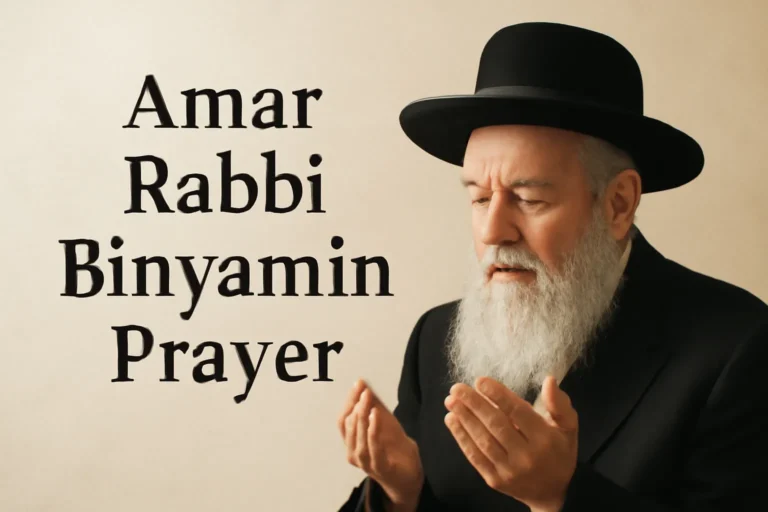
The question of how to approach a prayer for lost objects is one that appears in many Jewish communities,
and it centers on a historic figure known for helping in times of trouble. In this article, we examine Rabbi Meir Baal Haness and the
traditions surrounding the prayer for lost objects, or variations of it, used to seek assistance in locating misplaced items.
We will discuss who Meir Baal Haness was, why people turn to this tradition when something valuable or meaningful goes missing,
and how to use the different forms of the supplication in a respectful, mindful way.
The topic blends history, custom, and personal practice. While different communities may have distinctive versions or phrases,
the underlying intention is similar: to cultivate patience, focus, and trust in a higher order while engaging in a hopeful plea for aid.
This article presents a practical guide, describes several variations of the prayer for lost objects, and offers steps
for a thoughtful and contemplative practice. It also highlights the importance of intention, sincerity, and ethical considerations
when seeking help for a misplaced possession.
Who was Rabbi Meir Baal Haness?
Rabbi Meir Baal Haness is a prominent figure in Jewish lore, remembered for acts of kindness and miraculous interventions.
While the exact biographical details of his life belong to the larger tapestry of rabbinic tradition, the name is associated
with stories of mercy, charity, and patterns of supplication that many communities find meaningful when facing difficult situations.
In common practice, the name Meir Baal Haness is invoked not only for healing or relief in emergencies,
but also for finding things that have gone astray. The idea is that a compassionate, attentive leader can intercede on behalf of
a person who is anxious about a lost item, and can help restore order or grant a sense of clarity in a moment of distress.
The tradition of prayers and segulot for lost objects
Across Jewish communities, there exist various paths for seeking the recovery of lost or misplaced items. Some of these practices
are described as segulot—customary acts believed to bring favorable outcomes. Others are more formalized prayers,
recited with a quiet mind or in a small group depending on local custom. While not every item will be recovered, the process
of turning toward a hopeful supplication can offer consolation and perspective.
In broad terms, the practice often combines intention, structured recitation, and a moment of pause to reflect on
what the loss means, not only in material terms but also in personal meaning. Some people add elements such as lighting a candle,
saying a short psalm, or placing a small reminder near where the item was last seen. The exact sequence varies by community, but the
common thread remains: the act of turning toward hope with disciplined focus.
Variations of the prayer for lost objects
When people search for lost items, they may encounter a few distinct forms or variations of the supplication. Below are several
common variants you might come across in families or synagogues. Each variation is designed to fit different contexts, and many
practitioners adapt the language to suit their own understanding and prayerful posture.
Standard paraphrase for a lost item: A concise petition addressed to Meir Baal Haness or to God, asking for
help in locating the misplaced object and for clarity so one can retrieve it with calm and trust.
Long form supplication: An extended version that includes a short set of introspective lines, recognition of the item’s importance,
and a closing assurance to redouble one’s efforts to maintain order and gratitude regardless of the outcome.
Short form or silent recitation: A brief, often whispered or internal, prayer suitable for moments when time is limited,
focusing on intention, concentration, and a hopeful plea to be guided toward the item.
Psalm-augmented variation: A version that accompanies the request with a short psalm or verse, chosen for its themes of return, light, and guidance.
A candle and contemplation variant: A ritualized practice that adds lighting a candle and a moment of silent reflection before reciting the supplication.
Family-friendly or transliterated forms: Versions adapted into the local language or with transliterations to make the prayer accessible to children or new learners.
Community-led recitation: In some neighborhoods, a small group assembles to recite a set of phrases together, offering mutual support and focus.
It is important to note that the core aim across these variations is not only to recover the object but also to cultivate patience,
humility, and a constructive mindset. Some people emphasize the ethical dimension: if a lost item belongs to someone else, one
should consider ways to return or inform, and not rely solely on a prayer to solve every problem.
Preparing to recite the prayer for lost objects
Before you begin any variation of the Rabbi Meir Baal Haness prayer for lost objects, take a moment to prepare your
intention and the space around you. Preparation matters because it helps align the heart with the act of supplication and discourages
rushing through words without meaning.
Find a quiet space where you can focus without interruptions.
Clarify what is lost in concrete terms: a description of the item, where it was last seen, and when you last recall
having it in your possession.
Inspect your surroundings briefly to ensure you have exhausted obvious possibilities. The prayer is not a substitute for practical searching.
Choose a form of the variation you want to use—short form, long form, or a version augmented with psalms or candles.
Set a time for the recitation, whether it is at dawn, midday, or evening, to establish a rhythm that suits your schedule.
Beyond the mechanics, approach the practice with humility and intention. The goal is not to demand results,
but to invite guidance, patience, and awareness. You may also discuss the situation with a trusted friend or mentor if you find it helpful to
articulate your thoughts aloud before beginning the prayer.
Step-by-step guide to using the prayer
The following step-by-step outline offers a practical framework for a mindful recitation. It can be adapted to the variation you choose
and to the personal customs of your household or community.
Step 1: Center your mind
Take a few slow breaths to settle the body and quiet the mind. This pause supports greater focus as you proceed with the supplication.
Step 2: State the request clearly
Describe the item you have lost with as much detail as possible, including its appearance, approximate size, and the last place you remember handling it.
Step 3: Choose the form
Decide whether you will recite a short form, a long form, or an arrangement that includes a brief psalm or candle ritual. The form should fit your context and time.
Step 4: Use a respectful opening
Begin with a gentle address to Meir Baal Haness and, if you prefer, a brief acknowledgment of God or a higher power. The opening sets the tone for humility and hope.
Step 5: Present the petition
Offer the main plea in a straightforward, earnest manner. You may phrase it as seeking guidance to locate the object and to return it to your hands or to another rightful owner if necessary.
Step 6: Express gratitude and humility
Even before you find the item, acknowledge the support of a larger order, and thank the source of wisdom you choose to invoke. Gratitude helps sustain a calm heart.
Step 7: Close with a pinched or gentle seal
End the recitation by reaffirming your intent, with a closing note of trust, and, if appropriate, a quiet moment of reflection or a brief blessing.
A practical note: you may repeat the process once or twice, depending on your situation. Repetition without coercion or desperation can help
maintain balance and keep the practice meaningful rather than merely procedural.
The language used in the different variations of the prayer for lost objects often blends direct requests with symbolic ideas.
Common themes include light as guidance, return as a renewal of order, and a sense of partnership with a higher force that oversees both
the small details of daily life and the larger patterns of existence.
Light and clarity: Phrases that emphasize illumination reflect the hope that confusion will clear, enabling you to see where the item is.
Return and restoration: The theme of returning the lost object to its rightful place mirrors a broader desire for balance and integrity.
Patience and trust: Emphasizing patience reminds the practitioner that some outcomes unfold in their own time, and trust is part of the process.
Responsibility and action: The ritual often sits alongside practical searching, underscoring that spiritual effort does not replace earthly effort.
When you encounter different phrasing—such as a paraphrase of the supplication or a community variation—look for the shared ideas: humility, hope,
and a disciplined turn toward a higher source for guidance. The exact words matter less than the sincerity of the intention and the attentiveness of the heart.
How to use it in daily life: practical guidance
The use of the Meir Baal Haness prayer for lost objects can be integrated into daily life in a way that is gentle and practical.
Below are some practical tips to help you incorporate the practice without it becoming a ritual that feels forced or performative.
Consistency: If you choose a particular form, try to use it consistently for similar situations. Consistency helps build a reflective habit.
Context: Use the supplication when you are genuinely unsettled by a loss, rather than as a test of the windfall of luck.
Mindful searching: Pair the recitation with a focused search, making a note of places you have checked and ideas you have not yet explored.
Ethical considerations: If the lost object is part of another person’s possession, consider informing them or taking steps to rectify the situation in a timely and considerate manner.
Reflection: After recitation, take a moment to reflect on what the event teaches you about organization, memory, and gratitude.
For households that observe a more formal structure, you may establish a small routine—set a specific time, gather a few family members for support,
and create a quiet corner with a candle and a small note of the description of the item. Even a modest ritual can create space for calm and clear thinking.
Common phrases and their meanings in variations
When exploring different variations of the prayer for lost objects, you will encounter a variety of phrases.
Here are some representative themes and what they signify, explained in plain terms.
“Help me find the item with integrity and care” — Emphasizes honesty in the search and a respectful approach.
“Bring back into light that which is hidden or misplaced” — Uses imagery of light to denote clarity and revelation.
“Guide my steps to the place where it lies” — Invokes a sense of direction and purposeful motion.
“I trust in a benevolent order that oversees our possessions” — Expresses faith in a larger order and patience in the process.
You may find paraphrased lines in local customs or translated versions. The risk with paraphrase is that it becomes detached from tradition;
the benefit is accessibility and personal resonance. In either case, the aim is to invite focus, gentleness, and hopeful attention to the task.
A thoughtful approach to Rabbi Meir Baal Haness’s prayer for lost objects includes awareness of ethical boundaries and personal intention.
The practice should be approached with humility, not with coercive requests or demands. It is a spiritual or emotional aid, not a guarantee.
Acknowledge uncertainty: Accept that sometimes a thing is not recoverable or that it has moved beyond your reach for reasons beyond human knowledge.
Remain open to multiple outcomes: The item might be found in unexpected places or might belong to someone else who needs it more at this time.
Balance prayer with action: While reciting, continue practical searches and ask for help to organize and review places where items often disappear.
Preserve reverence: Treat the practice with reverence and avoid trivializing it with overly casual or flippant behavior.
If the lost object is especially valuable or emotionally charged, consider discussing the situation with a trusted community member or spiritual advisor
to reflect on the most appropriate approach. A respectful, patient attitude tends to be the most constructive in any situation involving loss.
What to do if the object is found or not found
The outcome of a prayer for a lost object may be as straightforward as discovering the item or it may require patience for a time.
In either case, you can honor the process by reflecting on what you learned through the experience. Whether you locate the object or not,
there are meaningful actions you can take afterward.
If the item is found: Express gratitude, bless yourself or your household, and take steps to secure or organize similar items to avoid future losses.
If the item remains unfound: Acknowledge the uncertainty with grace, continue to look if appropriate, and consider whether the item might be replaced or whether a different approach is needed.
Document and learn: Create a small note about where the item tends to disappear or how it tends to be misplaced, and implement a simple system to reduce future losses.
Share the wisdom: Talk about the practice with family or friends, focusing on how patience and mindful searching strengthened your resolve.
Even well-meaning practitioners can slip into patterns that undermine the intention of the practice. Here are common mistakes
and constructive ways to avoid them.
Overreliance on the ritual without practical searching: Remember to pair the supplication with concrete searching efforts.
Pressuring outcomes or demanding results: The prayer is a request for guidance and help, not a guarantee of immediate restitution.
Rushing through words without pause for reflection: Slow, deliberate recitation fosters receptivity and calm.
Neglecting sensitivity to others: If someone else owns the object or if there is a shared dependency on the item, consider ethical steps toward resolution.
Conclusion
The practice of invoking Rabbi Meir Baal Haness in connection with a prayer for lost objects offers a meaningful way to approach loss
with intention, dignity, and hope. Whether you adopt a short form for a moment of quiet reflection or a long form that
weaves in communal support and a few psalms, the essential elements remain consistent: a calm heart, a precise description of what is missing,
and a sense of trust in something greater than the immediate circumstances.
Use variations of the prayer for lost objects as tools for focus rather than as magical guarantees. Let the practice
be a way to cultivate patience, gratitude, and thoughtful action in your daily life. And remember that the recovery of an object
is not merely a physical event; it can become a moment of inner clarity—an opportunity to reassess organization, memory, and care.
If you would like to customize this guidance for your own tradition, you may consult a local rabbi, teacher, or community elder who is familiar
with the customary forms in your community. Respect for the tradition, attention to your own experience, and a balanced approach to prayer and action
will help ensure that the practice remains meaningful and ethical for you and for those around you.