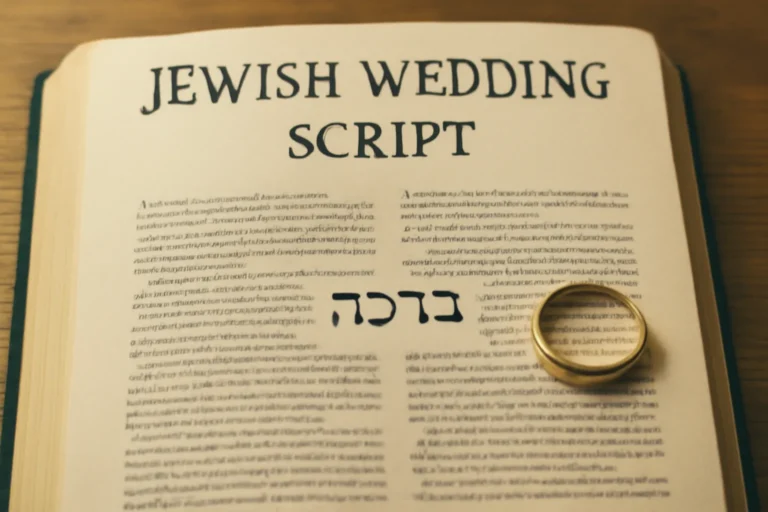
In the tapestry of Jewish wedding customs, the seven blessings—often called the Sheva Brachot—sit at the intersection of tradition and personal meaning. For couples planning a modern Jewish wedding, these blessings offer a framework that can be preserved, reinterpreted, and reimagined to reflect contemporary values while honoring centuries of liturgical heritage. This article explores how the traditional Sheva Brachot can be incorporated into a contemporary Jewish ceremony, with attention to language, inclusivity, symbolism, and practical design. You will find ideas for wording, delivery, and ritual adaptations, along with concrete examples that illustrate how the blessings can feel both timeless and timely. If you search for variations such as the 7 blessings jewish wedding modern, seven blessings for a modern Jewish wedding, or Sheva Brachot in a contemporary ceremony, you are not alone; many couples seek ways to honor the past while making space for who they are today.
Understanding the Sheva Brachot: themes, history, and purpose
The term Sheva Brachot literally means “seven blessings.” Traditionally recited over wine during the wedding ceremony, these blessings celebrate joy, companionship, creation, and the promise of a future built together. In a modern Jewish wedding, you may encounter variations in text and delivery, but the core intent remains: to sanctify the couple’s commitment in the presence of family, friends, and community.
Below is a practical way to think about the seven blessings, framed in accessible, modern language. Rather than stating exact liturgical text, we can summarize the blessings by their themes and offer adaptable English paraphrases you might use or personalize. This approach keeps the blessings meaningful while allowing for personal voice, inclusive language, and cultural diversity within the ceremony.
Blessing 1 — Joy in partnership: a celebration of joy that accompanies the couple as they begin this shared life.
Blessing 2 — The gift of companionship: the deep, sustaining bond that supports growth, mutual care, and resilience.
Blessing 3 — Creation and continuity: the act of building a home and family, rooted in tradition but planted in today’s world.
Blessing 4 — Sacred partnership: recognizing the couple’s covenant and the sacred quality of mutual respect, trust, and love.
Blessing 5 — Community and responsibility: the couple’s place within a larger community and their obligation to care for others.
Blessing 6 — Gratitude and blessing for life: appreciation for life’s gifts and the ongoing flow of blessings that sustain a family.
Blessing 7 — Hope for the future: generosity of spirit, hope for generations to come, and the promise of continuing growth together.
In variations of 7 blessings jewish wedding modern discussions, you will often see emphasis on inclusivity, gender-neutral language, and the option to include non-traditional voices—such as friends, mentors, or family members—who can offer readings or blessings. The flexibility of the seven blessings makes it possible to craft a ceremony that is both reverent and relevant to the couple’s identity and values.
Historical roots and the meaning for today
Origins in Jewish liturgy and rabbinic tradition
The Sheva Brachot have their roots in classical rabbinic literature and biblical-inspired liturgy, evolving over centuries into the central blessing sequence recited during the wedding under the chuppah. Over the generations, communities have preserved the cadence of these blessings while adapting phrasing, pronunciation, and the surrounding ritual to fit their cultural contexts. For many couples today, the act of reciting or paraphrasing these Blessings serves as a bridge between generations: the present ceremony becomes a living conversation with the past.
Why they matter in a modern context
In a modern Jewish wedding, the seven blessings operate on multiple levels. They are not only a liturgical form; they are spiritual messaging about partnership, responsibility, and grace. They invite the couple and their guests to witness and participate in a moment of gratitude and hope. When designed thoughtfully, the blessings become a narrative arc—opening with joy, deepening into mutual support, and culminating in a forward-looking confidence that the couple will navigate life’s changes together.
Practical guidelines for integrating the Sheva Brachot into a contemporary ceremony
Language and inclusivity
One of the most impactful decisions in a modern adaptation is language. You can preserve the meaning of the blessings while using inclusive language and words that reflect your identities, whether that means gender-neutral pronouns, non-English translations, or culturally expansive imagery. Some couples choose bilingual wording to honor a shared heritage or two families’ backgrounds. The goal is to ensure that every guest can hear, feel, and participate in the sentiment being expressed.
Use first-person plural language when appropriate (we, us, our) to emphasize partnership and community.
Offer an optional English paraphrase alongside the traditional blessing so guests can connect immediately with the meaning.
Invite the couple to customize some lines to reflect their life together, values, and hopes for the future.
Who should participate and how
Traditionally, a rabbi or officiant leads the blessings. In a modern Jewish wedding, you can expand or modify participation:
One or both members of the couple can recite portions of the blessings or accompanying readings.
Close family or friends may offer a short blessing or a personal reading that resonates with the blessing’s themes.
Anonymous or symbolic voices can read, allowing for a diverse range of perspectives and experiences.
Order and pacing
The sequence of the seven blessings can be preserved, but pacing matters. In a contemporary ceremony, you might break the blessings into two blocks—some before the ring exchange and some after—so the moment remains focused, intimate, and unhurried. You can intersperse readings, music, or reflective pauses to give guests time to absorb the meaning. The key is to avoid crowding and to maintain a sense of reverence while accommodating modern attention spans and ceremony lengths.
Designing the ceremony: ritual mechanics, symbolism, and adaptive rituals
The chuppah, wine, and ceremony space
The chuppah remains a powerful symbol of shelter and home. In a modern Jewish wedding, you can adapt the chuppah’s design—lighting, textiles, colors, and decorations—to reflect the couple’s aesthetic. The wine used for the blessings can be paired with a meaningful ritual, such as the sharing of a special glass that symbolizes unity, or a brief moment of reflection where guests are invited to raise a glass in solidarity.
Incorporating readings and music
Add readings that complement the blessngs: poetry about partnership, excerpts from sacred texts reinterpreted in inclusive language, or lines from contemporary authors who speak to family, equality, and love. Music can be a thread that runs through the ceremony—instrumental pieces, a song that carries personal significance, or even a moment of silence to honor loved ones. The point is to enhance the gravity of the blessings without turning the moment into a performance; it should feel participatory and intimate.
Symbols you can weave into the blessings
Rings or other tokens exchanged in alignment with the blessings, symbolizing commitment and continuity.
Unity candles or a ceremonial light that represents shared responsibility and future brightness.
Planting a tree or water ritual as a nod to growth and renewal, echoing the blessing themes.
Personalizing the seven blessings: practical approaches for a modern couple
Personalization does not mean discarding tradition; it means anchoring the blessing themes in your lived experience. Here are practical avenues for customization that keep the spiritual core intact while reflecting who you are as a couple.
Personal vows written to dovetail with the blessings: you can reference the Seven Blessings in your vows, or pair each vow with a corresponding blessing theme.
Couple-authored paraphrases: invite the couple to draft their own English paraphrase for one or more blessings, followed by a traditional recitation. This approach foregrounds meaning while retaining ritual structure.
Multigenerational voices: invite grandparents, siblings, or close friends to contribute a short blessing or blessing-inspired reading to extend the sense of continuity across generations.
Inclusive storytelling: weave in stories of how the couple met, how they support each other, and how they envision building a home together, aligning those stories with the blessing’s themes.
Accessibility practices: ensure the ceremony is accessible to all guests—clear amplification, large-print programs, and an occasion to participate meaningfully for people with different cultural backgrounds or religious backgrounds.
Sample wording and practical wording options for a modern ceremony
Option A: Traditional structure with modern paraphrase
The officiant speaks an opening line, then reads seven concise English paraphrases, one for each blessing, followed by a concluding blessing over wine. The couple and, if desired, selected speakers, can offer brief responses. This streamlined approach preserves meaning while fitting a contemporary flow.
Blessing 1 (paraphrase): May your union be filled with joy and shared wonder, as you begin a life of partnership and mutual care.
Blessing 2 (paraphrase): May you find in one another a steady source of comfort, laughter, and courage to grow together.
Blessing 3 (paraphrase): May your home be built on a foundation of respect, kindness, and shared responsibility.
Blessing 4 (paraphrase): May your love be sanctified as a covenant that sustains you through life’s changes.
Blessing 5 (paraphrase): May you remain connected to your community and use your strengths to heal and uplift others.
Blessing 6 (paraphrase): May gratitude accompany your days, and may you recognize the blessings that life brings your way.
Blessing 7 (paraphrase): May the future hold hope, continued growth, and a shared sense of purpose for generations to come.
Option B: Inclusive language, bilingual approach
If your ceremony embraces multi-language and inclusive language, you can present the seven blessings in English alongside a translation in another language, such as Hebrew, Spanish, French, or Amharic. The officiant can read a blessing in English while a close family member reads the translated version, inviting guests to listen in their preferred language.
Reading 1: A bilingual blessing that the couple and guests can follow together.
Reading 2: A reading chosen by a friend that aligns with the themes of partnership and home.
Reading 3: An optional reflection from a relative that connects the family’s lineage to the present moment.
Option C: Non-traditional voices and personal readings
To deepen authenticity, invite a close friend or mentor who can speak from the heart about what marriage means in today’s world. The readings can be brief, but they should connect to the blessings’ themes—joy, partnership, home, covenant, community, gratitude, and hope.
Examples of modern wording and ceremony sketches
The following are sample passages you can adapt. They illustrate how to weave modern voice with the blessing framework. You may use these as-is, or tailor them to reflect your family’s language, faith background, and cultural identities.
Example 1: Classic English paraphrase with modern tone
Officiant: «Blessed are You, Source of all life, who has given us joy and brought us together as partners in life. May your love be a source of strength, your home a shelter for each other, and your shared path a light for those around you. May your days be filled with gratitude, may your future be bright, and may you grow together in love and purpose.»
Example 2: Inclusive language and gratitude emphasis
Officiant: «Blessed are You, who sustains us, who binds hearts in mutual respect and dignity. May your union be blessed with equality, kindness, and resilience. May your home be a place of safety and joy, where differences are welcomed and strengths are shared.»
Example 3: Bilingual approach and personal touch
Officiant (English): «Blessed are You, God of life, who makes us one.» Guest (in [language]): «May your love endure.» Couple: «We are grateful for every day we share and every person who joins us on this journey.»
Example 4: Short, intimate moment with readings
Officiant: «As you begin your life together, we invite two readings from family members: a blessing for partnership and a blessing for community. May you always find joy in one another, and may you use your voices to lift up those around you.»
Beyond the blessings: integrating blessing into the broader ceremony arc
The seven blessings do not exist in isolation; they can anchor other ritual moments that define a modern Jewish wedding. Think about how the blessings intersect with:
The processional and recessional choreography, ensuring a smooth emotional arc.
Audience participation that invites guests to share a whispered blessing or a toast.
Interactive elements—such as a moment where guests raise their glass in solidarity during the blessings.
Environmental or social reflections, where the couple acknowledges their responsibilities to the world beyond their home.
When planned thoughtfully, the blessings weave into the entire ceremony, turning a liturgical moment into a living invitation for community, generosity, and hope.
Design and ritual considerations for different communities
Different Jewish movements and cultural communities bring distinct flavors to how the seven blessings are presented. Whether your background is Orthodox, Conservative, Reform, Reconstructionist, or secular Jewish, or you identify as interfaith or unaffiliated, you can render the blessings in a way that respects your beliefs while preserving a sense of sacredness. Here are some tailoring ideas:
Orthodox or traditional observations: retain a reverent tone, keep the blessings in their liturgical framework, and use traditional Hebrew texts alongside a clear English paraphrase for guests who do not read Hebrew.
Progressive or inclusive contexts: emphasize inclusive language, non-binary pronouns, and a collaborative ritual that invites participants from various backgrounds to engage with the text.
Interfaith partnerships: honor both faith traditions by featuring readings from both partners’ communities, provided the timing and flow honor the dignity of each tradition.
Nonreligious or secular Jewish ceremonies: lean into the universal themes—love, partnership, home, community, gratitude—with a sense of ceremonial beauty without doctrinal claims.
Writing effectively about the seven blessings in a modern context
If you’re a wedding planner, officiant, or couple drafting a ceremony, consider these writing tips to ensure the seven blessings land with clarity and warmth:
Clarify the intent: articulate that the blessings are a ceremonial arc honoring a shared life, not a ritual merely for tradition’s sake.
Keep sentences concise and meaningful, avoiding overly long or archaic phrasing that might distance guests.
Offer a bilingual option: provide a simple English paraphrase and an additional line in a partner language, so guests can listen in their preferred language.
Balance formality and intimacy: the tone should feel ceremonial yet personal, so that both the couple and their guests feel touched.
Test the flow: rehearse to ensure the blessings fit within your ceremony’s duration and with the surrounding readings and music.
The role of the officiant and the couple in delivering the blessings
In a modern Jewish wedding, the dynamic between the officiant and the couple can be collaborative. Some couples prefer to take turns reciting portions of the blessings, while others may have fully spoken blessings delivered by the officiant, with the couple offering a few lines of their own. One approach is to have the officiant set the sacred frame, then invite the couple to deliver a personal message linked to a specific blessing. This approach preserves the ritual’s gravitas while foregrounding personal meaning.
A practical checklist for arranging Sheva Brachot in your wedding plan
Confirm the blessing text with your officiant and ensure you have a clear English paraphrase if needed.
Decide who will read or recite the blessings and whether readings will be bilingual.
Determine the placement of the blessings within the ceremony and the overall flow.
Coordinate wine, glassware, and any additional ritual props (chuppah, lighting, etc.).
Prepare a short, meaningful ending that connects the blessings to the couple’s vows and shared future.
Common questions about the 7 blessings in a modern wedding
Here are some frequently asked questions and practical answers for couples exploring modern approaches to the Sheva Brachot:
Q: Can we skip the traditional wine blessing? A: Some couples opt to replace wine with grape juice or another symbolic element that fits their values. It’s acceptable to adapt the ritual while maintaining the blessing’s intent.
Q: Can we invite non-traditional voices to read the blessings? A: Absolutely. The blessings can be opened up to close family, friends, or even community members who bring a personal perspective that resonates with the couple’s life together.
Q: How can we maintain solemnity while making it contemporary? A: Focus on clarity, intention, and reverence. The language can be contemporary, but the moment’s gravity should be preserved through deliberate pacing and sincere delivery.
Conclusion: sustaining tradition through contemporary love
The idea of 7 Blessings Jewish Wedding Modern is not to replace tradition, but to breathe new life into it. The Sheva Brachot offer a scaffold on which a couple can build a ceremony that feels both deeply rooted in memory and alive with the realities of today. By balancing timeless blessings with personal expressions, by inviting a broad circle of voices, and by crafting language that honors all guests, a modern Jewish wedding can become a luminous ceremony—one that invites joy, honors covenant, and leaves space for the future to unfold with hope.
If you are planning a wedding with a focus on timeless blessings adapted for today, you are engaging in a long-standing process: translating ancient words into living meaning. With thoughtful wording, intentional inclusion, and careful ceremonial design, the seven blessings can illuminate a couple’s path forward in a way that is both culturally rich and personally resonant. The result is a ceremony that honors the past, celebrates the present, and keeps open a future filled with possibility for generations to come.